A marketing link is a specialized URL embedded with tracking parameters that let you measure exactly where your traffic comes from, which campaigns convert, and how users engage across every digital channel. The industry standard term for this practice is campaign URL tracking, and the core mechanism is UTM parameters. As of Q2 2026, three required UTM parameters , utm_source, utm_medium, and utm_campaign, are mandatory for accurate Google Analytics 4 attribution. Without them, your campaign data is guesswork. Link Squeeze is built specifically to help digital marketers and e-commerce professionals create, manage, and analyze these links at scale, turning every click into a measurable outcome.
What makes an effective marketing link?
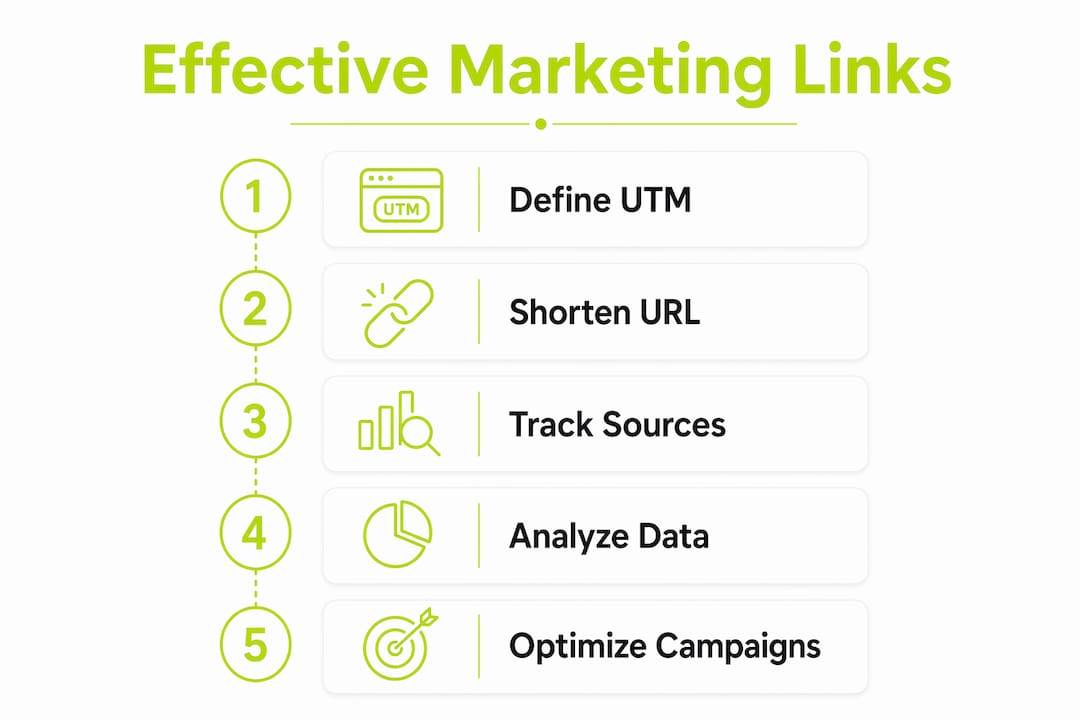
An effective marketing link combines technical precision with usability. The URL must carry the right tracking data, load fast, look trustworthy, and work across every channel where you distribute it.
The required UTM parameters are:
- utm_source – identifies where the traffic originates (e.g., Google, newsletter, Instagram)
- utm_medium – defines the channel type (e.g., cpc, email, social)
- utm_campaign – names the specific campaign (e.g., summer_sale_2026)
- utm_term – optional; captures the paid keyword that triggered the ad
- utm_content – optional; differentiates between multiple links in the same campaign, such as two different banner ads
These five parameters give you a complete picture of what drove a click. The first three are non-negotiable for Google Analytics 4 tracking. The last two add granularity that matters most in paid search and A/B testing scenarios.
Link shortening is the next layer. A raw UTM-tagged URL can run 200+ characters. That length kills click-through rates in email subject lines, social captions, and SMS. Shortening the URL to something like this brand.co/summer26 fixes the aesthetics problem and makes the link shareable. Branded short links go further by replacing a generic domain with your own, which builds recognition and trust before the user even clicks. Research consistently shows that branded links outperform generic short links on click-through rate.

Pro Tip: Never apply UTM parameters to internal links on your own website. Internal UTM usage creates self-referral loops that corrupt your analytics data and misattribute traffic sources. Reserve UTMs exclusively for external campaign URLs.
How do marketing links support link building strategies?
Link building and campaign tracking are two distinct disciplines, but they share the same infrastructure: the URL. Understanding how they interact makes both more effective.
Traditional link building relied on cold outreach, directory submissions, and reciprocal linking. That approach declined sharply post-2023 as Google updates and AI-powered search deprioritized low-quality links. The dominant strategy in 2026 is Digital PR, which earns editorial mentions and backlinks through original research, expert commentary, and newsworthy content.
The data on backlinks is still compelling. Pages ranking #1 on Google have 3.8 times more backlinks than pages ranking in positions 2 through 10. That gap does not close without a deliberate link acquisition strategy.
Brand mentions now correlate with AI search visibility at 0.664, more than three times stronger than backlinks alone at 0.218. This means your brand appearing in articles, podcasts, and social conversations, even without a clickable link, drives measurable search presence in 2026.
For marketers building links from scratch, four approaches work well in 2026:
- Brand mention reclamation – find unlinked mentions of your brand using tools like Google Alerts, then contact the publisher and request a link
- Broken link building – identify dead links on relevant sites, create replacement content, and pitch your page as the fix
- Digital PR campaigns – publish original data or research that journalists and bloggers will cite naturally
- Internal linking architecture – structure your own site with hub-and-spoke models to signal page importance to search engines at zero cost
Marketing links enhance link building attribution by letting you track exactly which backlink sources send converting traffic, not just raw clicks. That insight tells you where to invest your PR and outreach efforts next.
What are best practices for managing marketing link performance?
Managing digital marketing links well requires three things: clean data collection, accurate attribution, and a regular review cycle.
Data collection starts with avoiding the most common mistakes:
- Never reuse UTM parameter values inconsistently (e.g., “Email” vs. “email” vs. “e-mail” for the same channel. GA4 treats these as separate sources)
- Always use lowercase values in UTM parameters to prevent data fragmentation
- Avoid UTM parameters on internal URLs to prevent self-referral data corruption
- Use a shared UTM naming convention across your entire team, documented in a spreadsheet or link management platform
In GA4, attribution modelling defaults to data-driven attribution, which distributes credit across all touchpoints a user interacted with before converting. This is more accurate than last-click models, but it requires clean UTM data to function correctly. If your UTM values are inconsistent, the model cannot properly assign credit.
Pro Tip: Build a master UTM taxonomy document before your next campaign. Define every accepted value for utm_source, utm_medium, and utm_campaign. Share it with every team member who creates links. Consistency in naming is the single biggest factor in reliable attribution data.
The table below outlines the core performance metrics to track for each marketing link:
| Metric | What it measures | Why it matters |
|---|---|---|
| Click-through rate (CTR) | Percentage of users who click the link | Indicates link placement and copy effectiveness |
| Conversion rate | Percentage of clicks that complete a goal | Measures campaign ROI directly |
| Bounce rate by source | Percentage of single-page sessions per UTM source | Reveals traffic quality from each channel |
| Session duration | Average time on site per UTM source | Shows content relevance for each audience segment |
Iterative testing is the final piece. Run two versions of the same campaign link with different utm_content values to test subject lines, placements, or creative. Review performance weekly. Kill underperforming variants fast and scale what works. Link retargeting adds another dimension by letting you build retargeting audiences from every click, even clicks on links you share on third-party platforms.
What tools simplify creating and managing marketing links?
The right tools reduce the time it takes to build, deploy, and analyze campaign URLs from hours to minutes.
Free and entry-level tools cover the basics:
- UTM link builders generate properly formatted tracking URLs without manual string construction
- Link shorteners compress long URLs for social, email, and SMS distribution
- Link preview generators let you control the title, description, and image that appear when a link is shared on social platforms
Advanced link management platforms go further. They centralize all your campaign URLs in one place, enforce naming conventions, and connect directly to analytics platforms. The best platforms in 2026 also support retargeting pixel integration, which means every click on your short link adds that user to a custom audience in Facebook Ads or Google Ads. That turns a simple link share into a full retargeting funnel.
Link Squeeze combines all of these capabilities in one platform. The free UTM builder generates correctly formatted tracking URLs instantly. The link shortener supports custom branded domains, so your links carry your brand name rather than a generic domain. Shopify merchants get native integration for accurate order attribution, connecting link clicks directly to purchase data. For performance marketers, the short links for email campaigns feature tracks engagement at the individual link level across every send.
AI-powered attribution is the next frontier. Platforms that connect CRM data with UTM-sourced click data can now predict which traffic sources are most likely to convert, before a campaign ends. That shifts link management from a reporting function to a predictive one.
Key Takeaways
A marketing link without UTM parameters, branded formatting, and clean attribution data is just a URL. The combination of all three is what turns clicks into campaign intelligence.
| Point | Details |
|---|---|
| UTM parameters are mandatory | Use utm_source, utm_medium, and utm_campaign on every external campaign link for accurate GA4 data. |
| Never UTM internal links | Applying tracking parameters to your own site’s links corrupts analytics and creates false traffic attribution. |
| Brand mentions outperform backlinks in AI search | Brand mentions correlate with AI search visibility at 0.664 versus 0.218 for backlinks alone. |
| Branded short links build trust | Custom domain short links increase click-through rates and reinforce brand recognition before the click. |
| Consistent naming conventions protect data | A shared UTM taxonomy prevents data fragmentation and makes attribution modeling reliable. |
Why most marketers are still leaving link data on the table
The uncomfortable truth I’ve learned after years of auditing marketing campaigns is this: most teams build links correctly once and then stop thinking about them. They set up UTM parameters for a launch campaign, get clean data for two weeks, and then let the naming conventions drift as new team members join and old documentation gets ignored.
The result is analytics dashboards full of “direct” traffic that is actually misattributed email or social traffic. I’ve seen e-commerce brands attribute 40% of their revenue to “direct” simply because their UTM values were inconsistent. That is not a data problem. It is a process problem.
The shift toward AI-driven search makes this worse, not better. Brand mentions now drive AI search visibility more strongly than backlinks, which means the value of every PR mention, podcast appearance, and social post is rising. But if you cannot track which of those activities drives traffic and conversions, you cannot allocate budget to the ones that work.
My advice is simple: treat your UTM taxonomy like a product. Version it, document it, and enforce it. Pair that discipline with a link management platform that does the enforcement automatically. The marketers who win in 2026 are not the ones with the most creative campaigns. They are the ones who know exactly what worked and can do it again.
How Link Squeeze helps you get more from every link
Link Squeeze gives digital marketers and e-commerce professionals a complete set of tools to build, track, and act on campaign link data without stitching together five separate platforms.
The free marketing tools suite includes a UTM builder, link shortener, and link preview generator, all in one place. Branded short links let you replace generic domains with your own, building trust with every share. Retargeting pixel integration turns every click into an audience segment you can reach again in paid channels. Shopify merchants get direct order attribution, connecting link performance to actual revenue. Whether you run paid search, email, or social campaigns, Link Squeeze gives you the data to know what is working and the tools to act on it.
FAQ
What is a marketing link?
A marketing link is a URL embedded with UTM tracking parameters that identify the traffic source, channel, and campaign driving each click. It enables precise attribution and campaign measurement in platforms like Google Analytics 4.
What are the required UTM parameters for a marketing link?
The three required UTM parameters are utm_source, utm_medium, and utm_campaign. These are mandatory for accurate Google Analytics 4 attribution as of 2026 standards.
Can I use UTM parameters on internal website links?
No. Applying UTM parameters to internal links creates self-referral loops that corrupt your analytics data and misattribute traffic sources. Use UTMs only on external campaign URLs.
How do marketing links affect SEO and link building?
Marketing links help you track which backlink sources send converting traffic, not just raw clicks. Combined with Digital PR strategies, they give you attribution data to prioritise the link-building efforts that actually drive revenue.
What is the difference between a short link and a branded short link?
A short link compresses a long URL using a generic domain. A branded short link uses your own custom domain, which increases click-through rates and signals credibility to users before they click.